When I was 16, my brother died. The shock was so severe; I don’t think I fully responded to it until much later in my life. My heart was broken for the first time though. Four years later, my father died. I was angry. Broken and angry because life was unfair. Our family was left forever incomplete and changed. On this day, 19 February 2018, my mom died. By now, I’ve learned to live with brokenness and losses, but her death left a massive hole in my heart. My world’s axis shifted, and I’ve been living with a sense of not being completely myself since.
This life is harsh and cruel. It deals blows unexpectedly and undeservingly. My family was the best of families. We loved each other. We had the best of parents and most tremendous appreciation for one another. It was not fair. Yet, here I am. Broken parts and hole in my heart, but I am still standing. I am not angry anymore, and I don’t blame anyone for all the trauma.
I choose to be a conqueror instead of a victim. Why? Because warriors get hurt on battlefields – it is the nature of war. We are in a battle of good versus evil, whether we agree or not. This life will not ask your permission to engage in the fight. It will bring it to you. How you respond will determine your victory or defeat.
I don’t know about you, but the older I get, the more it seems to me that there’s an acceleration in the rotation of the earth on its axis. My imagination conjures an image where it spins faster and faster, leaving havoc-filled schedules infused with haste. This image seems to be the only plausible explanation as to why life seems to get more demanding and why time is flying by like an arrow, leaving one wondering what happened. And before we know it, we’ll be looking back in our review mirrors reminiscing about another year passed.
We’ve already passed the first quarter of 2018 and considering the ever increasing shortage in time, the rest of 2018 will soon go down in history as “done and dusted”. As we are progressing towards the halfway mark of this year, most of us are looking forward to a quick, but rejuvenating rest and quality time with our loved ones during the upcoming school break. Some of us are making plans to go on holiday or buy new things, while others consider better saving options. We do these things because we can. Yes, we fall under the small minority fortunate enough to consider holiday destinations or new possessions. We are also in the advantageous position to make plans because we have the time and options to do so.
Before we continue to do and accumulate more, perhaps it’s time to take a step back from our plans and be thankful. I’ve heard many people call this year a dark horse, referring to an apocalyptic symbol because so far this year was difficult for them. Terrible in the sense that they’ve lost loved ones or that they’ve had extremely challenging health issues. Others experienced various wounds in different spheres of life, but the point is that several had a dark cloud hanging over their lives. Maybe you are one of these people; perhaps you’re not.
Nevertheless, I want to point out to you that you’re still alive. You’re breathing, living and hoping. Others did not make it. You have a family; whether you have close relations with them or not, they are there. You have the opportunity to engage with them and to restore relationships. I know of quite a few orphanages, where the family is more than just a blood connection. They choose to be family. Maybe it’s time for us to do the same with those family members we wrote off long ago. We still have time.
There’s always something to be thankful for. – author unknown
Instead of focusing on the new furniture you are hoping to buy, first, consider the fact that you have some. Most people in our country have none. They make due with things that you and I throw away at the dump site. We are quick to take for granted what we have and forget that what we have today was once the prayers of yesterday. Maybe we ought to want less and appreciate more what we already have.
Namibian sunset – There’s beauty all around us. Just look and see.
It’s a natural reaction for people to demand and expect more when their successes have elevated them to higher heights. So often we become arrogant without realizing it. We speak in a condescending tone to others because we think that our title or position dictates it, or we demand more because we feel entitled to it. Think about the waitress that messed up your order at the last restaurant you visited. Did she genuinely deserve your scorn? Why is it that we as people so quickly forget our humble beginnings? Once upon a time, you might have been in her shoes, or perhaps you were the student with an equal demeaning job washing the cars of thankless people. Perhaps you too once knew the pangs of hunger and the shame of embarrassment. Let’s be thankful for our station in life. We have worked hard to get here, but let’s also be appreciative of the journeys we’ve traveled to get here, and at the same time remember to be compassionate and kind towards those who are still emerging and climbing their ladders.
We need to get into the habit of cultivating an attitude of gratitude. It may sound difficult, but it’s not that challenging at all to do so. We merely need to realize that there’s something to be thankful for, every day, everywhere we go. It’s in the laughter of children playing in a dusty road, the glow of our magnificent Namibian sunset that we get to witness almost daily, the curious stares from wildlife standing next to our roads when we take a road trip, or the funny little aerial wiggle our warthogs do when they run into the bush. It’s even found in the happy welcome your dog shows you daily, or in the song of birds early in the morning. There’s always something that has the potential to bring us joy and to remind us to be thankful. It all depends on what we focus on at that moment.
It’s the simple things in life that gives us joy.
Let us take stock of our lives now and pay attention to that which is more valuable than our wants, complaints and concerns. In the end, the beauty of life is captured in each precious moment in time. Seek out these precious moments and be grateful for them.
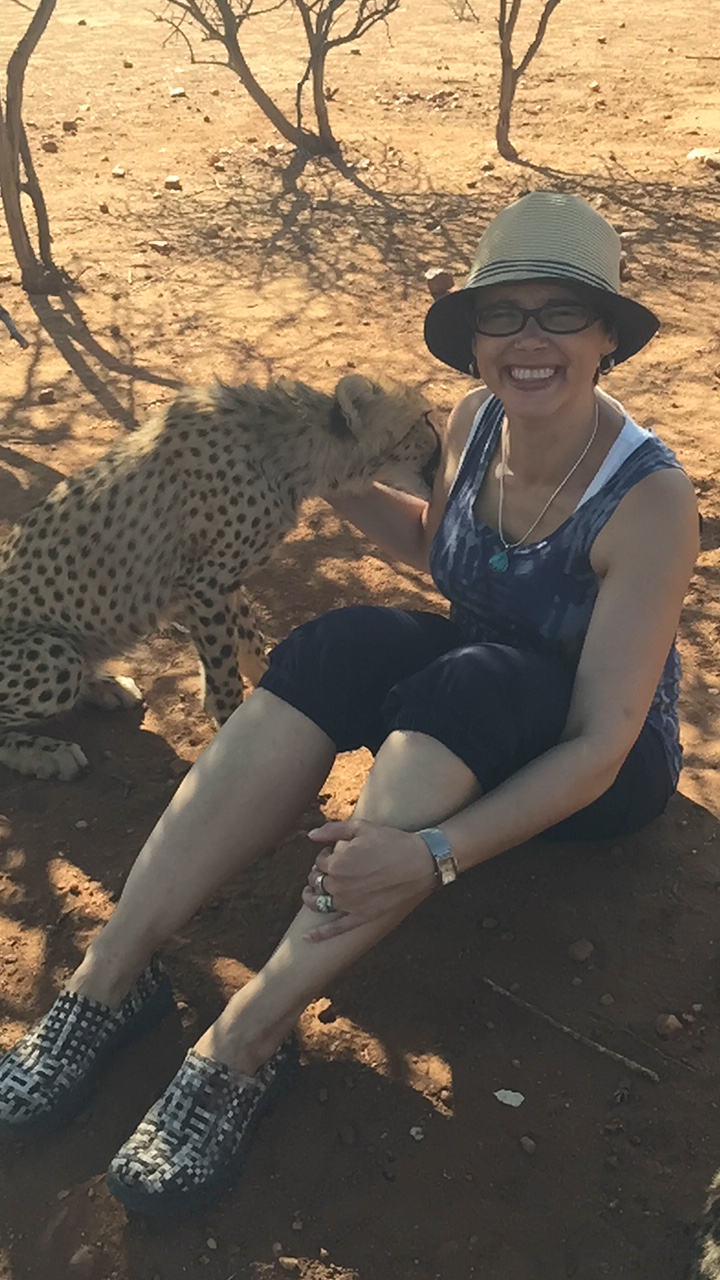
Noreen at Naankuse Wildlife Sanctuary – appreciate the moment.
Transparency International, a Berlin-based global Non-Governmental Organisation (NGO), ran a global survey to attempt to measure the level of corruption in specific countries. “Over two-thirds of the 176 countries and territories in this year’s index fall below the midpoint of our scale of 0 (highly corrupt) to 100 (very clean). The global average score is a paltry 43, indicating endemic corruption in a country’s public sector.”
These insights paint a frightening picture and inspire distrust towards leaders in general, and hopelessness for the future.
But, beyond political and business leadership, this phenomenon is becoming more and more evident in all sectors of life. We cannot deny that this dishonest canker-worm is eating away at the very fabric of society, but what can we do to prevent it?
As much as we try to fight corruption or mitigate less-than-perfect business outcomes due to prior decisions that were taken, throwing it around like hot coal or playing the blame game, will not solve the problem. It’s preached widely in all sectors of business and politics that transparency and accountability are the way forward to fight corruption. Perhaps it’s time to take the bull by the horns and implement a solution that will bury the victim mentality and create a culture of ownership for the choices we make and the final decisions we take in our respective organisations.
Man must cease attributing his problems to his environment and learn again to exercise his will – his personal responsibility.
Albert Einstein
This fall from integrity towards a more sinister version of ourselves can only be eliminated by dealing with the cause of this social disease. It’s deeper than statistics on paper or forming committees to address the problems. We often forget that we are human and not operating programs or machines capable of carrying out a complex series of actions automatically or without flaws. When we are expected to perform and deliver perfection in a not so perfect world, exercising transparency and taking ownership of our choices and decisions, becomes easier said than done. – And herein lies the root of the issue. People are afraid to take ownership and demonstrate accountability because it exposes their imperfections or failures.
We are raised with the notion that mistakes are taboo and it’s best to avoid making them in the first place. We are not taught though that they also provide the basis for experience and the prevention of repetitive behavior. We implement punishments for mistakes, but we fail to give an equal amount of instruction or encouragement to pick up the pieces and to try again. So, our society conditions us to accept an illusion of perfection rather than to acknowledge an honest mistake, rethink our cause, and redirect our efforts towards a more suitable outcome. This, of course, permeates into every area of our lives, including our professions.
Living with the illusion of perfection and a constant need to perform or to prove ourselves, inevitably creates self-esteem problems. When people fail to take responsibility for their lives, they often blame someone else for the bad things that happen and consequently nurture an empowered victim mentality. This mindset poisons and spreads into relationships, ambitions, achievements, work, business, etc.
“When you blame others, you give up your power to change.”
Unknown
The only way around it is to consciously decide to deal with the toxic elements in our thinking and behaviour. By doing this, we do not escape responsibility anymore. Instead, we take control, face the issues and act accordingly. It is through our consistent action that we enable ourselves to grow and achieve. In return, we build higher levels of self-esteem and the usual fears of acceptance, validation and the burden to perform,start to correct themselves. By gaining internal stability and accepting ourselves as imperfect beings on a journey towards improvement, we can uproot the negative downward spiral in our broader society and address the lack of accountability and ownership in our daily lives.
It is not easy to take ownership, but it is essential. Our actions become the catalyst that inspires better behavior, influencing spheres beyond ourselves.
Every year various people from all walks of life work vigorously together as a powerful unit to fight against cancer, and every year the results are remarkable. For most of us, it’s not just a good cause, but a personal engagement when we join in as fellow warriors in the fight against cancer. I can testify that I’ve lost a father and a brother to this dreadful disease and I know of many other people affected by the same pain and loss. Therefore, most annual assaults on cancer stem from a mutual desire to collectively join forces in eradicating this disease, because we are aware of the suffering and the impact that it has on lives. It gives us comfort knowing that there is a continuous war going on and that every action works towards defeating the power of this mighty enemy.
It is strange though that through all our commitment and efforts, we allow a different kind of cancer to eat away at our beings. This one we choose to entertain and give a place in our lives, contradicting our stance. We allow it to enter our hearts, and then it slowly poisons our minds, trapping us in bitterness. I am referring to the lack of forgiveness… and by my definition: the cancer of the soul.
Now, you may frown upon this statement, but I would like to point out that just like cancer, “unforgiveness” takes its time to spread and do harm. It festers in one’s soul, consuming your inner light, as it slowly but surely spreads to different areas of your life. Its aim is always to destroy. An incident or various events may have caused your pain, but you will notice that the longer you hold on to it, the more it changes you as a person. Perhaps it initially started out in anger, and then it escalated to resentment with an apparent distrust towards your inflictor. Soon enough you find that you have difficulty trusting all people and before you know it you’ve become dissatisfied with yourself and your life, continuously blaming others for all your problems.
To forgive is to set a prisoner free and discover that the prisoner was you.
– Lewis B. Smedes
Someone once said that the reluctance to forgive is like drinking poison and expecting your enemy to die. The reality is that although you may, or may not, have been responsible for your pain; unwillingness to forgive keeps you locked up in prison while it steals your joy. Most people think that forgiveness is meant for the one who caused the harm. This is not the case. We choose to forgive to set ourselves free from that who holds power over us. Many times, people try counselling, or some form of restoration, to help them cope with past hurts, but still struggle to overcome them. One can work through issues, but if you fail to pull it up from the roots, it will grow back again. The longer someone refuses to set him/herself free from a self-imposed prison, irrespective of who or what caused the pain; they will have difficulty living a happier life.
We see needy and desperate people every day of our lives. Thus, every one of us knows that we do live in a broken world filled with broken people and that our society is bowed to sorrows and agonies. You see it in the haunted eyes of an abused child, or the sorrow-filled voice of a divorcée, and the tired face of a widow who doesn’t know how to provide the next meal for her kids. However, although we see the result, we often fail to understand that the cause is our imperfection. No one, not a single one of us, is perfect. It includes your colleague at the office, or the person in the mirror staring back at you. Because of our imperfections, we are guaranteed to make mistakes, fail and hurt and be on the receiving end of it too. Now we can continue to point fingers and shout for justice, but this does not set people free form their inner pains. I suppose all that we can do is to forgive one another and ourselves, while we pick up the pieces and try again.
Don’t you think it’s time that we also unite against this cancer in our souls and defeat it through mutual love, understanding and respect? Every day of our lives, every one of us is fighting some inner battle. Let’s be kinder, more helpful, and conscious of our imperfections in our daily dealings with one another.






 Touch Base